
An American Pizza Encyclopedia
Ray Varghese Madathil
There are few love affairs documented in more sordid detail than the one between America and Pizza. A staple of parties and take-out meals, Pizza is a guaranteed crowd-pleaser. For foodies, New York is the mecca of American pizza; the famed New York slice, immortalized by films like Spider-Man 2 (2004), is perhaps the most famous incarnation, but as we residents of Chicago know, it is far from the only one. Upon undertaking this pilgrimage for myself this spring, I found myself thinking back to all the slices I had tried since arriving in the States, consistently astounded by the regional varieties available. But I kept going back to the same questions: what exactly differentiates a Detroit-style slice from a New York square slice? And what differentiates that from a Sicilian slice?
There are far too many varieties of pizza to describe each one in detail, so, in the interests of space, I will narrow the list down to five, introducing a couple of classics and focusing on some of the noteworthy square varieties that are becoming increasingly popular.
First, I’ll start with the aforementioned New York slice. Characterized by its thin crust (though not Neapolitan thin, which is mandated by Italian law to be about a tenth of an inch) and floppiness, the New York slice is typically baked in a gas oven and made with high-gluten bread flour, which gives it its satisfying chewy texture. Unlike the Neapolitan slice, which uses high-moisture, fresh mozzarella, the classic New York slice demands low-moisture, aged mozzarella in order to prevent a soggy crust or rubbery cheese, as the gas ovens run at lower temperatures than the Neapolitan wood-fired oven. The sauce, too, differs from the traditional, often featuring herbs mixed in, something also prevented by Italian law, which mandates that the sauce contain only tomatoes and salt. Walking down the street in New York, one is liable to see a pedestrian strolling by while munching on a floppy, folded slice, which harkens back to the roots of pizza as a portable fisherman’s breakfast, often eaten on the street.
The New York slice’s thinner, more heavily charred cousin is the New Haven slice, which is cooked in a coal-fired oven, resulting in a crisper texture. The dough of the New Haven slice is also fermented, preserving a slight chew despite its char. New Haven pizza is also known for its innovative choice of toppings, with the controversial but undoubtedly unique “white clam pie” featuring freshly shucked quahogs, a specialty of nearby Rhode Island.
Now onto the first non-round entrant in our list: Detroit-style. Traditionally prepared in blue steel automotive pans, the Detroit-style slice has a thicker yet airy crust, and was originally served with the toppings underneath the cheese and the sauce ladled on top. Made popular by national chains (like Jet’s), this unique preparation method results in an extra-crisp crust, as the fat from the Wisconsin-style brick cheese and toppings essentially fries the parts of the pizza that come into contact with the pan. The cheese around the edges also caramelizes, creating a lacy ridge known as frico.
While in New York, I had the privilege of trying some New York square pizzas from the famous Prince Street Pizza and Mama’s TOO!. Prince Street’s pizza, dubbed the “SoHo Square” after the Manhattan neighborhood from which it originates, is a Sicilian-style pie fried in olive oil, giving it a golden, crunchy base. The fat from its “Cup and Char” natural-casing pepperoni adds even more indulgence to the dish, preserving extra puddles of flavorful pepperoni fat.
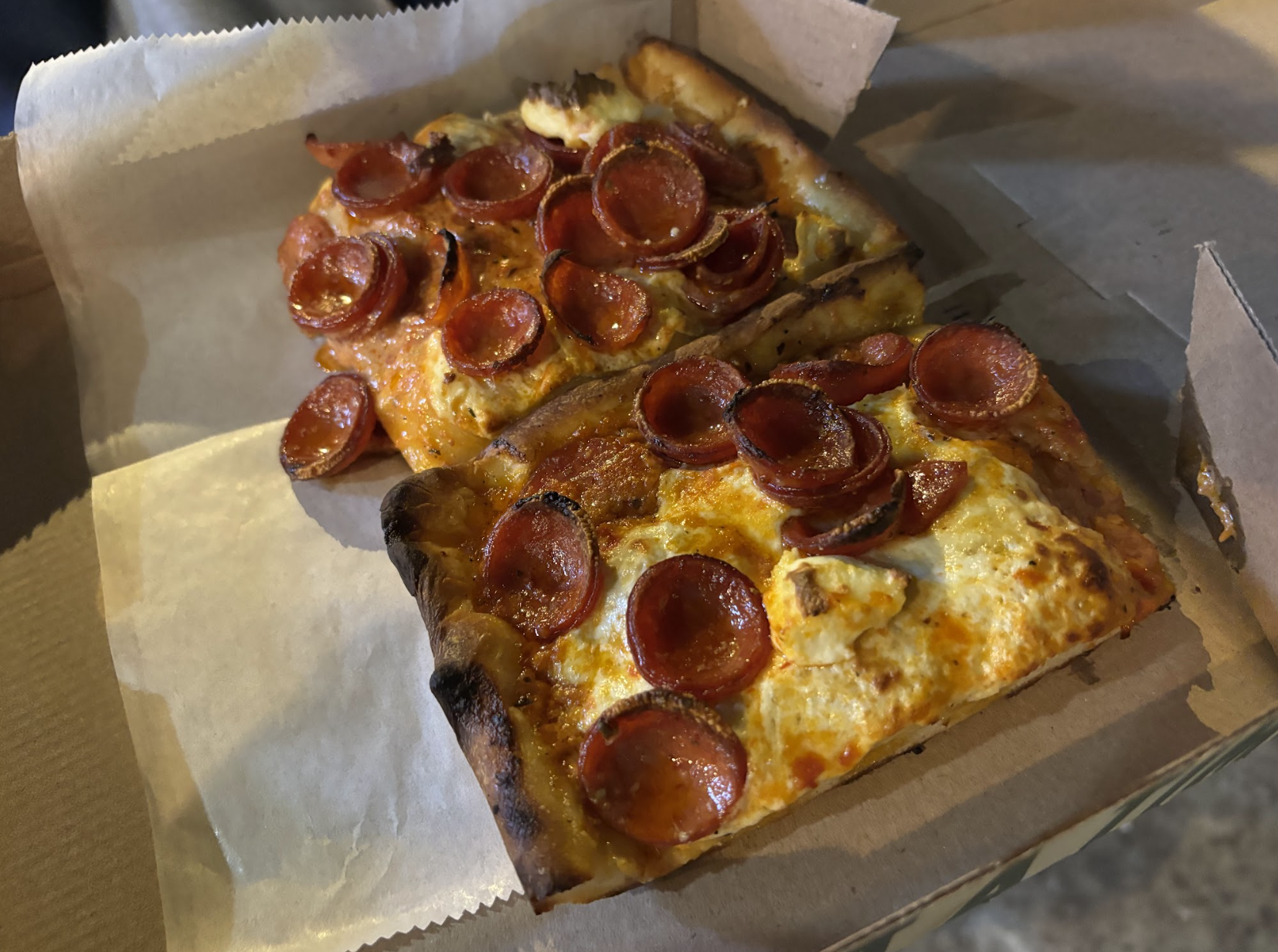
Prince Street Pizza
Mama’s TOO!, on the other hand, is known as a Neo-Sicilian slice; it uses a high-hydration, fermented dough to create an airy, almost sourdough-like crust that is crisp and light. I ordered their Angry Nonna slice—hot Soppressata, aged mozzarella, Calabrian chili oil, and hot honey. They are undoubtedly masters of the frico, and it made for an outstanding slice.
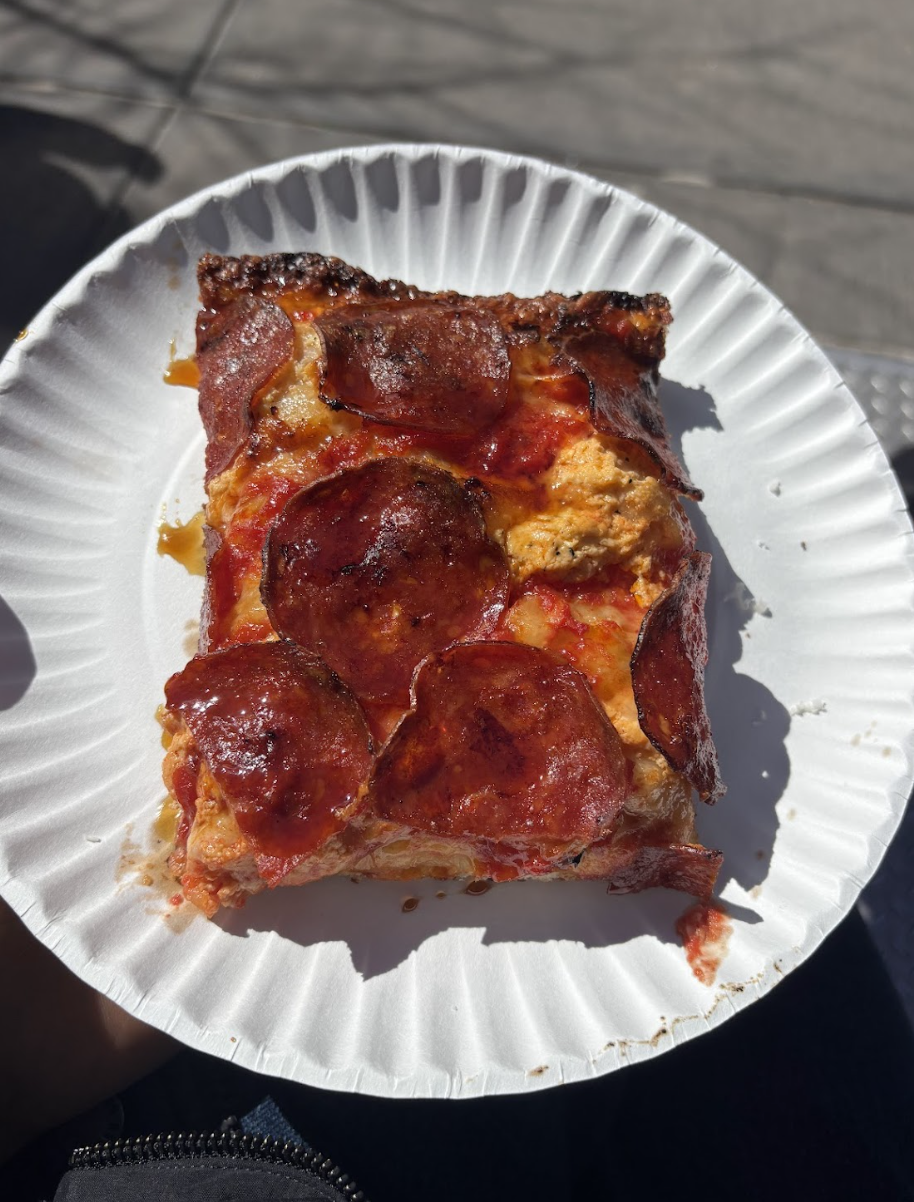
Mama’s TOO!
Now our comparisons get a little more confusing. Grandma-style pizza, a Long Island signature, is often confused with Detroit-style pizza because it shares its rectangular shape and cheese-first preparation. But this is where the similarities end: Grandma-style pizza has a thinner, focaccia-like crust and uses extra virgin olive oil as its primary fat source. Both Detroit and Grandma-style pizza descend from sfincione, a focaccia-like Sicilian square “pizza” made with Caciocavallo or Pecorino and topped with anchovies, onions, and breadcrumbs.
As a bonus, let's consider a unique style of pizza popular in our very own Windy City—and no, not deep-dish. The tavern-style pizza is ultra-thin and crunchy, though depending on the particular region within the Midwest, this too can vary: the Milwaukee-style “cracker crust” is firmly in the crunchy category, while the Minnesota-style calls for a slightly softer texture. The tavern-style pizza, in contrast to New York-style, is typically rolled out rather than hand-tossed and sliced into small squares rather than wedges. Legend says that the moniker “tavern-style” originated from—you guessed it—taverns, which served the savory dish in order to tempt patrons into lingering longer, and hence ordering more alcohol. Apart from its thirst-inducing properties, some theories suggest that the tavern-style pizza was specifically designed to be easily held in one hand or supported on a napkin, hence its cracker-like crust.
While the round pie still dominates total sales, the square/pan pizza category is the fastest growing, with the 2026 Pizza Today Industry Trends report noting that Detroit-style pizza has broken into the top 5 most popular pizza styles for the first time ever. Pizza lovers are showing a marked preference for the textural satiety offered by the high-hydration, crunchy-yet-airy dough of square pies, with thick-crust pies (under which almost all square pies are included) now constituting a 35.6% share of the global pizza market. The rise of artisanal pizza has also played a significant role in changing pizza trends; Instagrammable pies using specialty ingredients and craft techniques are becoming increasingly popular, changing pizza from fast food and delivery fare into a culinary destination worth queuing for. Regardless of your thoughts on the square-vs-round, or thick-vs-thin crust debate, I, for one, am glad to have both options, and depending on the day, can see myself choosing either.
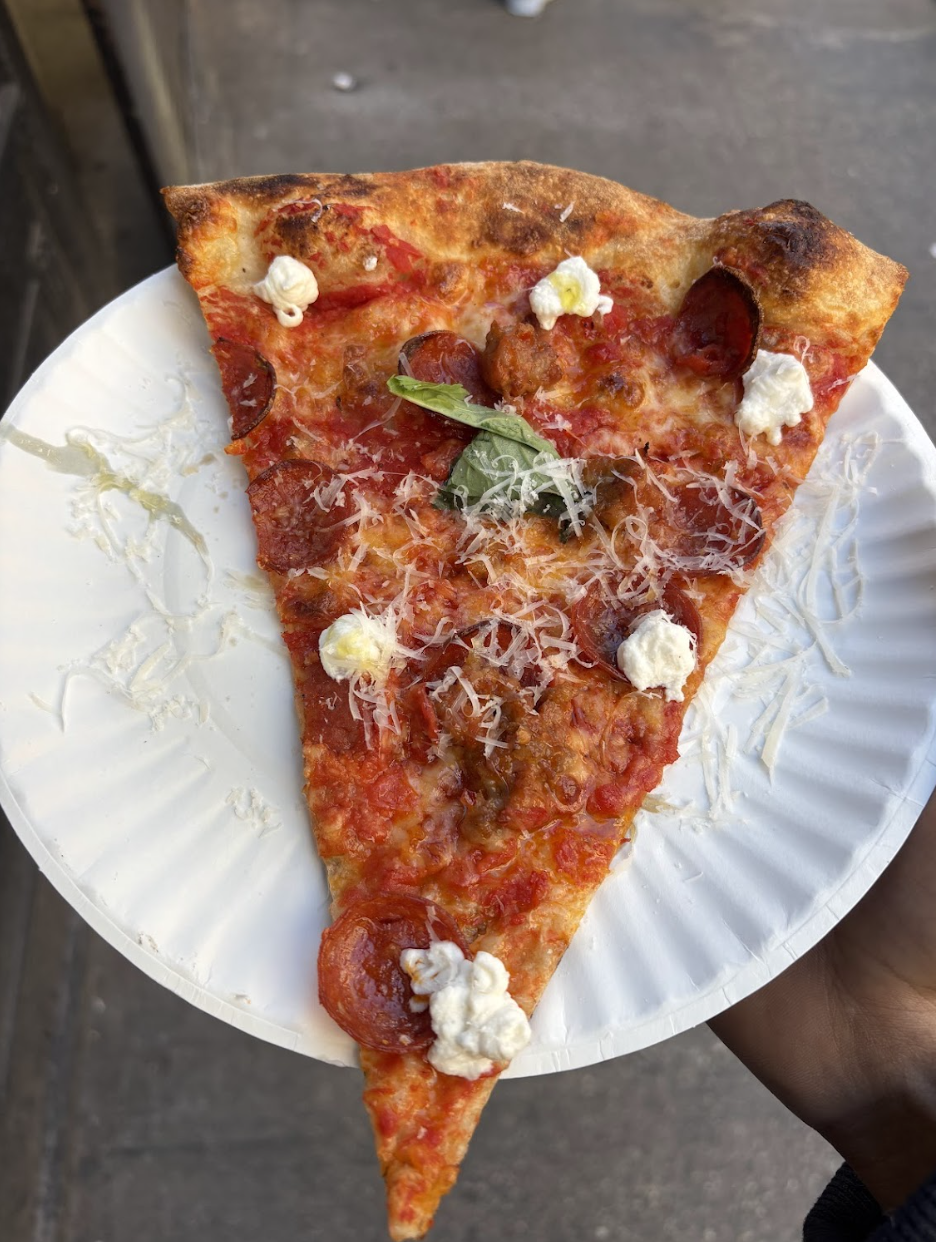
L'Industrie