
Berenjak Chicago Review
By David Kim and Harava Rahardjo
Founded by Kian Samyani, Berenjak opened its first location in London eight years ago, earning high praise and a Michelin Bib Gourmand. The Persian restaurant group now operates in many locations globally, from Dubai to Brooklyn. On Oct. 1, Berenjak arrived in Chicago, bringing its internationally acclaimed menu to the Windy City.
My roommate and close friend, David, first mentioned trying this new modern Persian restaurant after his sister raved about her experience at the London location. While researching the cuisine and scouring Berenjak’s website for available reservations, I, who notoriously has a terrible memory (something David likes to remind me of), realized I’ve actually tried it before. After a quick scroll through my reviewed restaurants on Beli, I saw the rating I gave the Berenjak in Los Angeles only a couple of months prior: a whopping 9.6/10! Now that the bar was set high, we geared up to try the newest addition to the Fulton Market District’s already eclectic food scene.
Berenjak is nestled in an intimate room on the second floor of Soho House Chicago. We visited on a Wednesday evening and were seated as soon as we arrived, despite arriving around ten minutes early for our scheduled reservation. The room was lit by candles on each table and soft, warm hanging lamps near the bar, creating a cozy, calm atmosphere. The carpets beneath our table had intricate patterns and designs, and the artwork on the walls added to the homey feeling of the place, while also reflecting the culture that the restaurant’s cuisine is rooted in. The crowd appeared to lean younger. Most guests were in their 20s or 30s, if I were to guess. The restaurant offers counter seating or table seating, including larger tables for groups, depending on what you prefer.
Soon after sitting down, we were greeted by our extremely kind server, who offered to take us on a tour through their menu. The food is split into four categories: breads and spreads (under “Noon O Mazeh”), kababs, sides/vegetables (under “Sofreh”), and stews/other meats (under “Khoresht”). Everything is made to be shared. Drinks can be chosen from a selection of Berenjak’s non-alcoholic “House Drinks,” beers, cocktails, wine, or soft drinks.
The food started coming out around ten minutes after we ordered. We started with the sourdough, sesame-seeded taftoon flatbread (the other option was the whole-wheat sangak bread) and ordered the black truffle olivieh (chicken mayo salad with potato, egg, salted cucumbers and black truffle) and the panir sabzi (Bulgarian white cheese, radish, fresh herbs and sesame seeds) as our spreads.
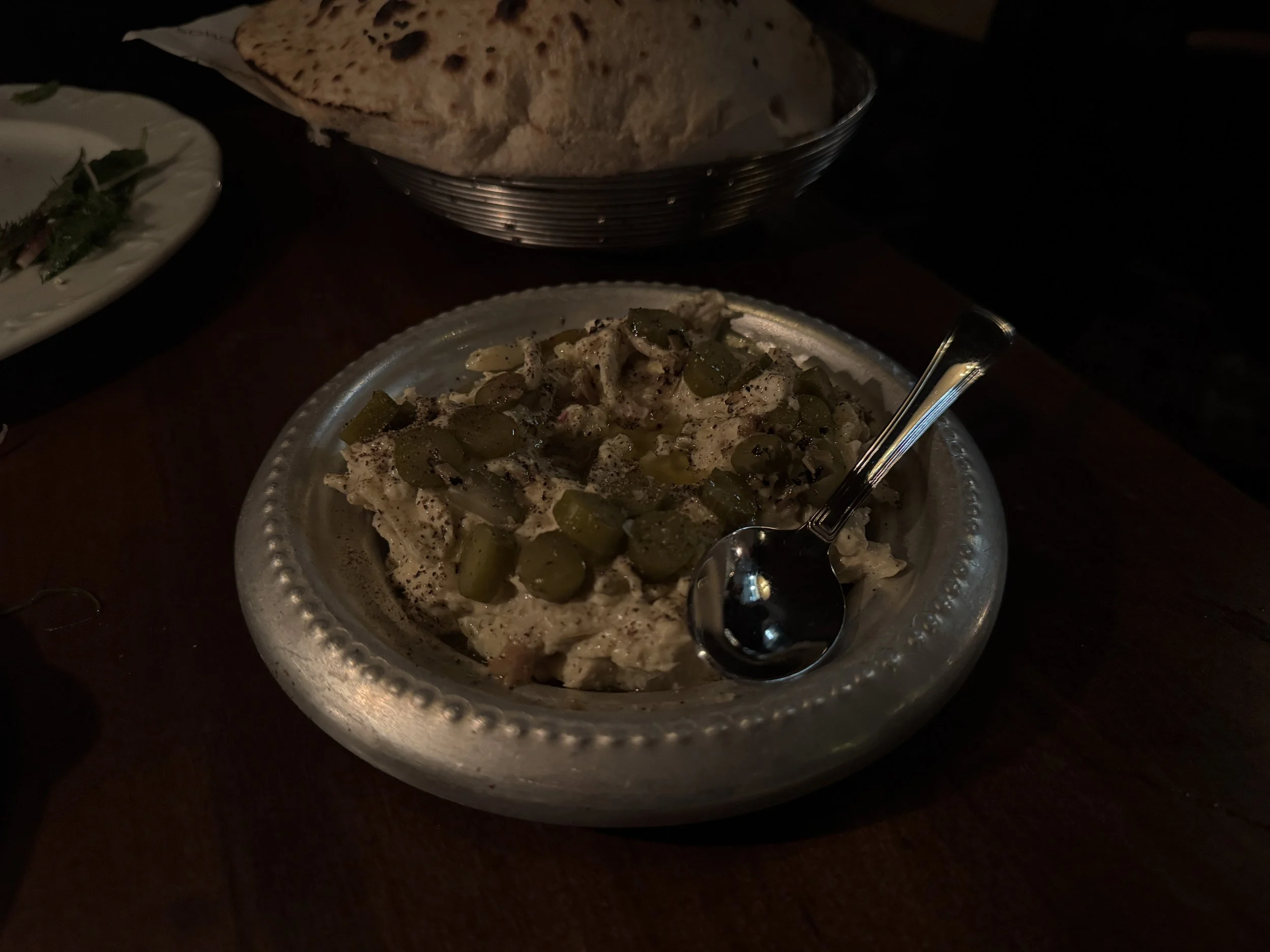
Black Truffle Olivieh ($22)
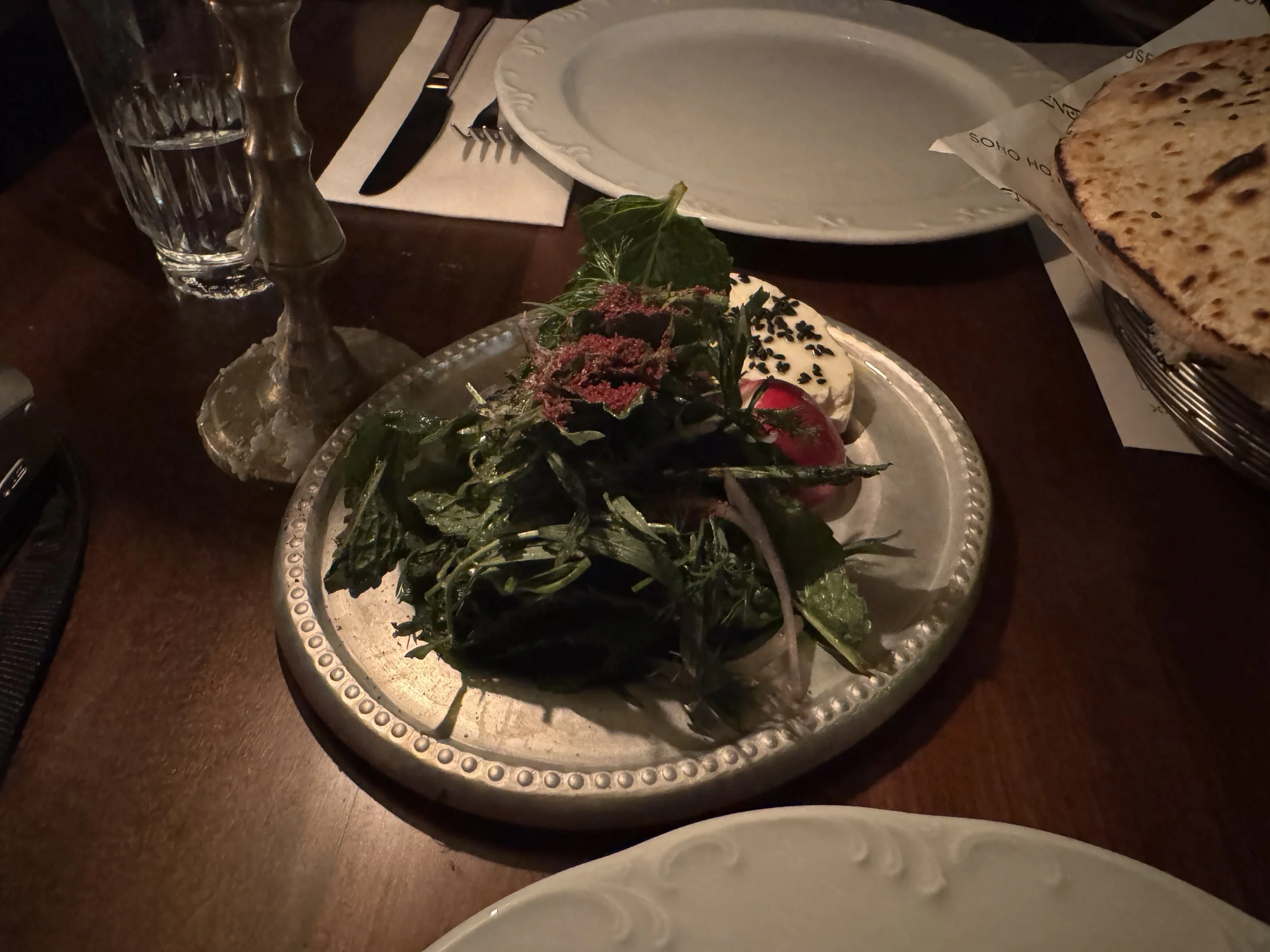
Panir Sabzi ($12)
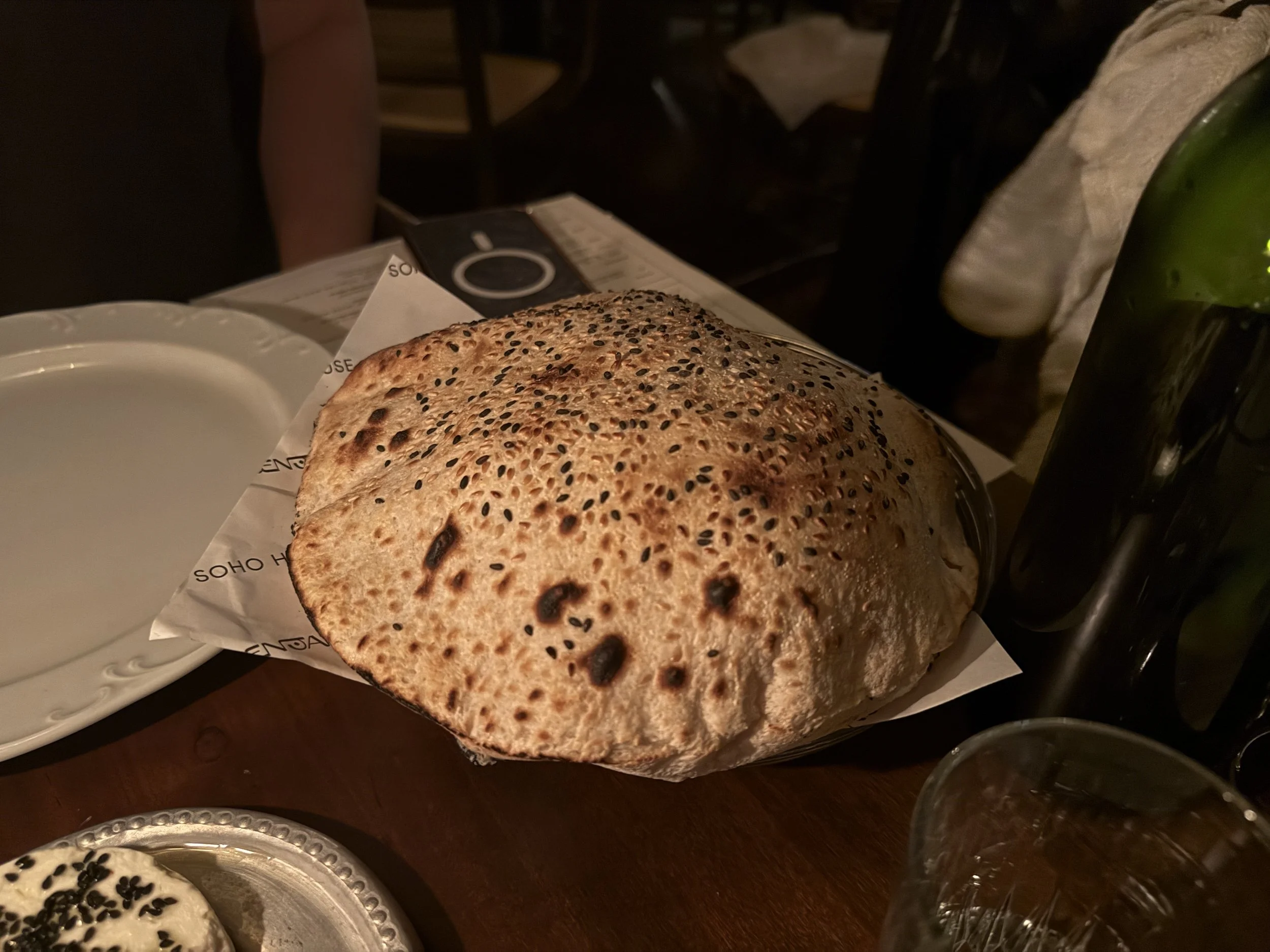
Taftoon ($9)
Harava’s Review: The bread was still warm from the oven and had a good balance between the softness and crunch that you would hope for from a flatbread. The spreads were honestly my highlight of the night. The black truffle olivieh perfectly complemented the taftoon bread, adding a creamy texture to contrast the feeling of the bread. I also loved the panir sabzi. It was rather small, so if you’re sharing between more than two people, you might want to order more.
David’s Review: The bread was very nutty and savory, highlighted by the black and white sesame seeds that dotted its pillowy exterior in a very aesthetically pleasing way. The black truffle olivieh was perfection. While technically a fusion dish incorporating Western influences and not traditionally Persian, it was one of my favorite dishes. The salty and creamy texture softened the chicken, making it extremely light – a perfect addition to the heavier bread. The panir sabzi was a good contrast as it was much heavier and more solid cheese. While I did not enjoy the radish, the cheese itself was a good sour addition to the buttery bread.
One of our very first dishes was the balal — Persian street corn. Four mini pieces of corn that had a nice yellow-brown charred color greeted our hungry eyes. Curiously, the corn was topped with some greens, which I quickly realized were cilantro, and a small piece of lemon. Both acted as a palate cleanser, adding an acidic and aromatic contrast to the sweetness and saltiness of the marinated corn. Thanks to the harmony of such flavors, each bite was dynamic and vibrant rather than intensely sweet or salty.
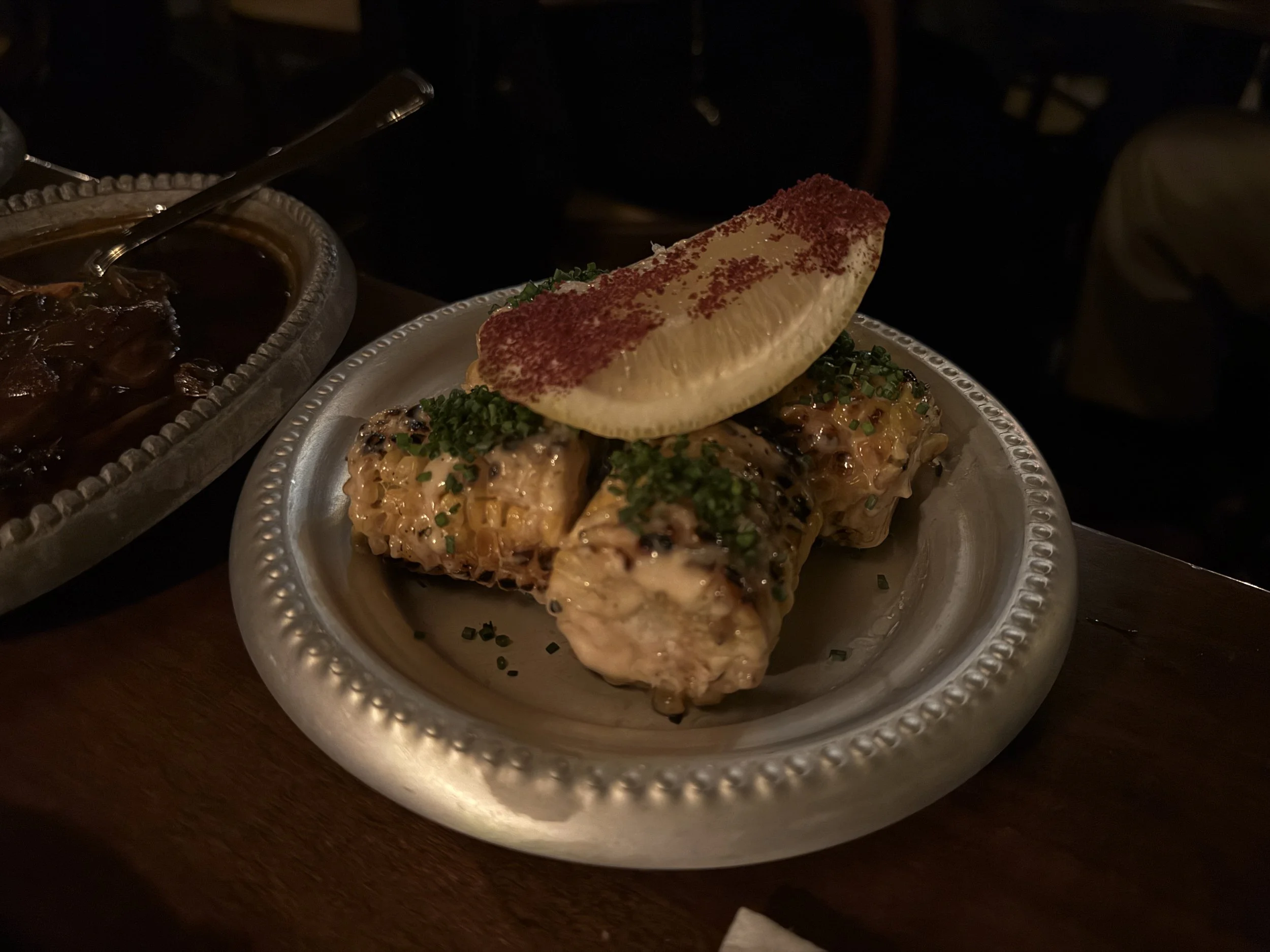
Balal ($13)
Harava’s Review: The corn was kind of hard to eat without getting the creamy toppings all over your mouth, but that was definitely not a negative for me. The cream completely melted in my mouth. The corn was rather small, however.
David’s Review: The corn was sour, sweet, and savory all at once, with the charredness further emphasizing the burst of flavor. The toppings helped ensure the flavors were not overwhelmingly strong, keeping us reaching for another bite.
Our main protein of the evening was the Koobideh kabab*, which our server explained was a traditional Iranian minced meat dish made from ground lamb. Plated on top of a warm flatbread, the meat is served with a lemon (to get rid of the gamey smell), raw white onions topped with herbs (a refreshing palate cleanser), and grilled tomatoes.
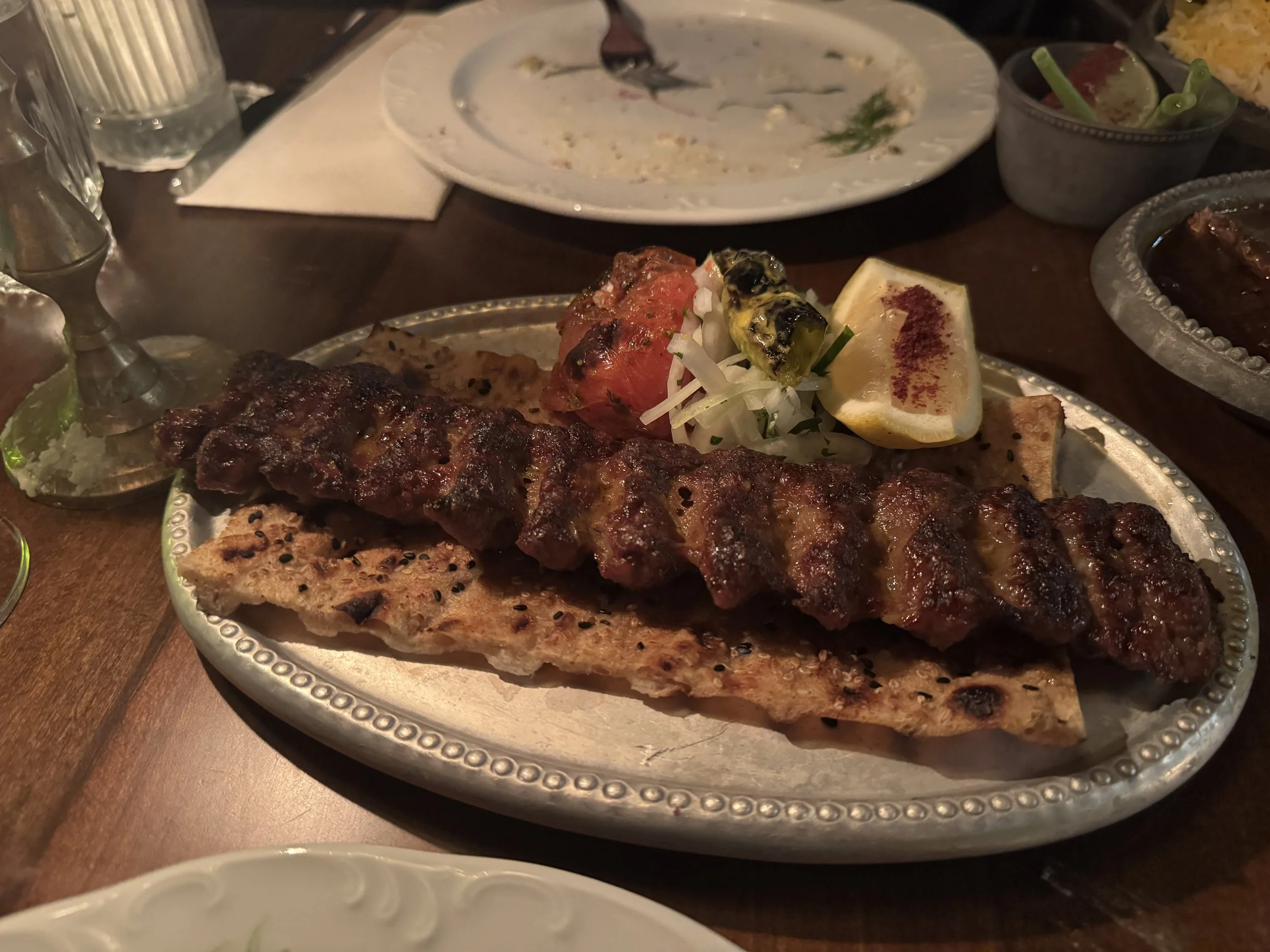
Koobideh Kabab ($28)
Harava’s Review: I don’t eat lamb that often due to personal preferences, but I might reconsider that after eating this kabab. It was so soft and made the chewing experience so satisfying. We were worried that it wouldn’t be enough for the two of us, but the portions were the perfect amount for two.
David’s Review: The kabab was extremely soft and tender, with just the right amount of juice. The thoughtful sides made the experience doubly enjoyable, helping ensure that no smell or taste is too overpowering.
Our second main was the ghalieh mahih, a traditional fish stew from Southern Iran. Berenjak presented us with two large pieces of seabass served dunked in a brownish-red sauce, along with a golden-yellow house rice to be enjoyed alongside it. The stew itself was a bomb of sour and spicy flavors from tamarind and red pepper. The house rice, on the other hand, was buttery and almost sweet, in comparison, with crunchy tadig** that surprise you in the middle.
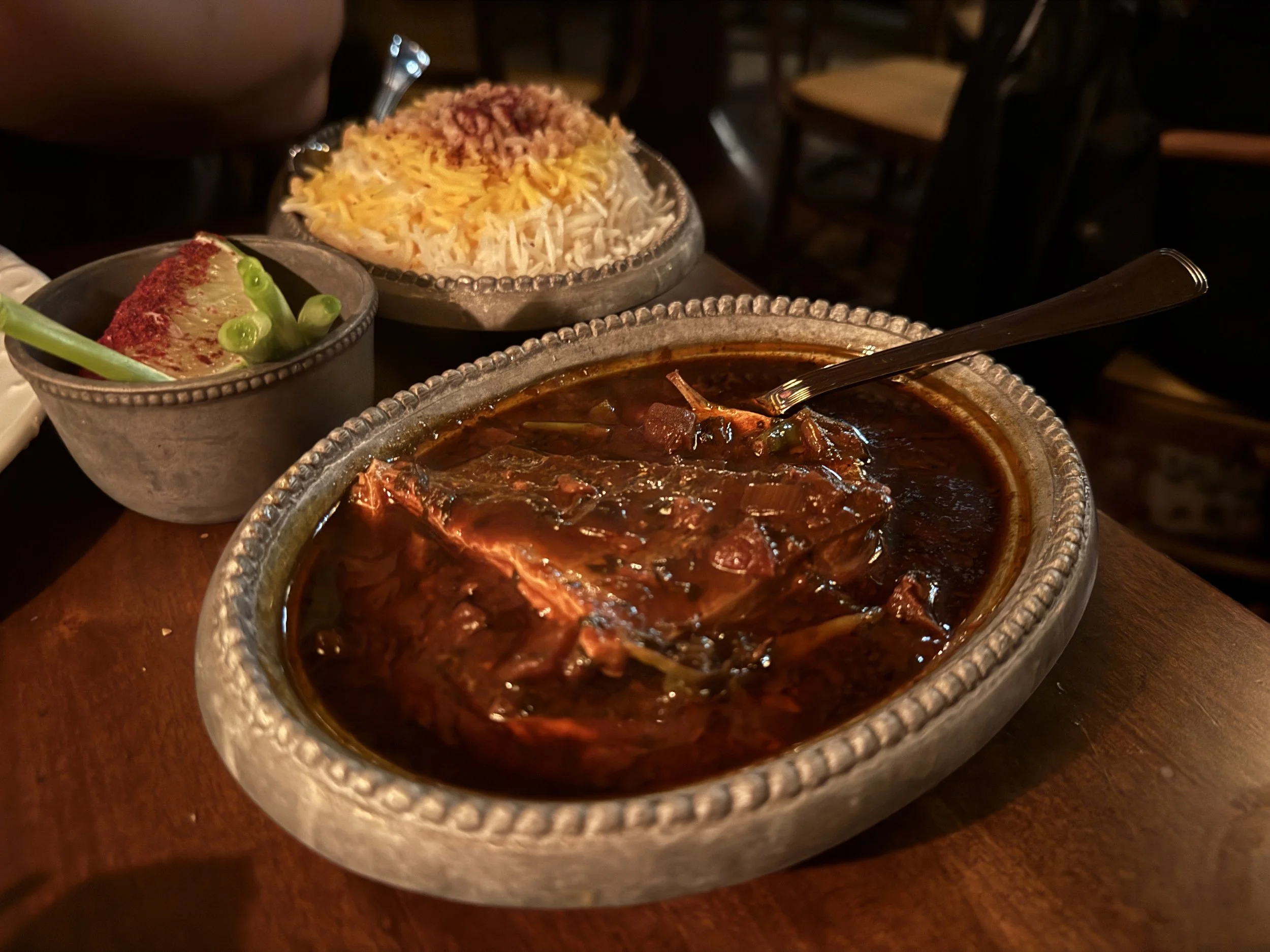
Ghalieh Mahi ($35)
Harava’s Review: Our server recommended the fish stew, and it definitely did not disappoint. While it was delicious, compared to everything we ate today, it did not make a huge impression on me. The house rice was amazing, though. I loved the slight crispiness of the rice paired with the buttery, smooth texture. If I were to come back, I’d definitely order the house rice again, but I’d probably want to try one of the other stews to compare.
David’s Review: The ghalieh mahih was reminiscent of a Thai curry — deep in flavor but not too thick in texture — yet with a completely different flavor profile. While I normally enjoy glutinous sticky rice more, the saffron rice was perfect for the house rice, especially as the texture of the stew itself was also light.
Harava’s Review of the Sparkling Tea: The taste is distinctly tea, but the carbonation (which is not too strong, so it still does not feel too much like soda) makes the drink unique. I was a little disappointed by the quantity, however, since it was only a small glass for $10.
David’s Review of the Doogh: Considering it was a “yogurt” drink, I expected it to be much sweeter, but it was surprisingly savory. It was similar, almost, to a more liquid version of Tzatziki, with a kick of carbonation.
Overall, Berenjak met our high expectations. Each item we ordered and the sequence in which it came out felt like we were having a well-organized course tasting menu. It was a great introduction to Persian cuisine, which we are now excited to explore further. While slightly on the more expensive end, at around $100 per person, we would say we were highly satisfied and is quite worth the price tag in comparison to other restaurants we have tried in Chicago. Our ratings were 9.8/10 (David) and 9.6/10 (Harava) on Beli!
*Notice that the Berenjak menu spells what we normally spell as “kebab” with an “a” instead of an “e”. Curious what the difference was, we did a quick Google search. Interestingly, while kebab is the standard European and English transliteration, the word in Farsi (Persian) actually sounds more similar to the “a” spelling rather than the “e” spelling. The “e” spelling originated from Turkish origins.
**Tahdig: a thin, crunchy, and golden crust of slightly browned rice that forms at the bottom of a cooking pot.